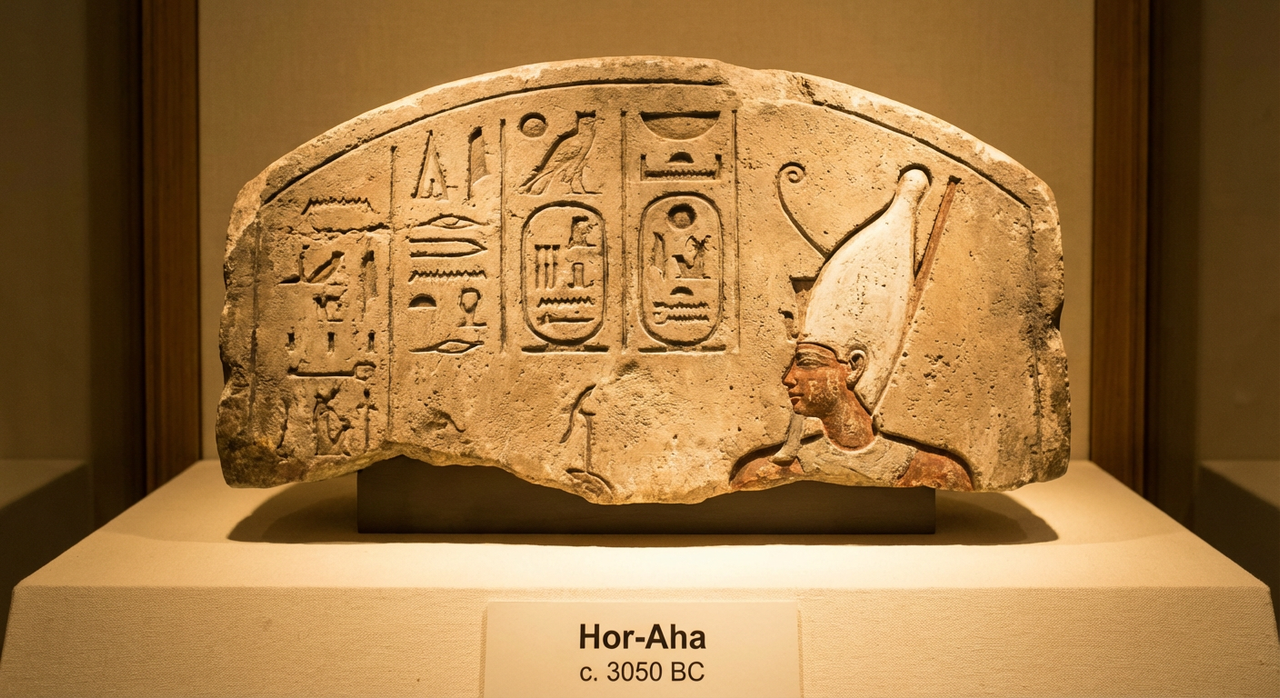
King Hor-Aha
The "Fighter King" who consolidated the unified state.
(Hor-Aha)
1Identity & Names
Hor-Aha is one of the first Egyptian kings verified by contemporary archaeological evidence. While later king lists are often fragmented, Hor-Aha's existence is confirmed through numerous artifacts from his reign.
- Horus Name: Ḥr-ꜤḥꜢ (Hor-Aha), meaning "Horus the Fighter." This aggressive name likely reflects his military efforts to maintain control over the newly unified Egypt.
- Nebty Name: Possibly "Men," which links him to the legendary founder Menes.
- The Menes Debate: Many scholars believe Narmer was the first king to be called Menes, while others argue the title passed to or was first adopted by Hor-Aha. The question remains one of Egyptology's great debates.
- Titles: King of Upper and Lower Egypt, Lord of the Two Lands.
2Chronology & Historical Importance
Hor-Aha's reign marks the crucial transition from the symbolic unification achieved by his predecessor, Narmer, to the establishment of a functional and centralized government.
- Reign: Approximately 3050 BCE.
- Dynasty: First Dynasty, Early Dynastic Period.
- Succession: He is generally considered to be the son of Narmer and Queen Neithhotep and the successor to the throne.
- Historical Role: If Narmer united Egypt by force, Hor-Aha was the one who made it work. He turned a conquered territory into a single, administered state.
3The Capital: Founding of Memphis
One of Hor-Aha's most significant and lasting achievements was the establishment of a new capital city, Memphis.
Memphis (originally Ineb-Hedj, "The White Wall") would remain the political and administrative heart of Egypt for over 3,000 years, a testament to Hor-Aha's foresight.
4Military & Political Activity
His name "Horus the Fighter" was not merely symbolic. Ivory labels and other artifacts discovered from his time record numerous political and military events, demonstrating an active and forceful reign.
- Internal Consolidation: Evidence points to campaigns to suppress rebellions within the Nile Delta, ensuring the north remained under southern control.
- Foreign Campaigns: Inscriptions suggest military expeditions into Nubia (to the south) and the Sinai (to the east), likely to secure trade routes and access to valuable resources like copper and turquoise.
- State Administration: His reign saw the early development of a state bureaucracy, including taxation systems and the organization of labor for royal projects.
5Key Archaeological Evidence
Our knowledge of Hor-Aha comes directly from the ground. Unlike later pharaohs, who left massive monuments, the story of these early kings is told through smaller, more personal artifacts.
- Ivory Labels: Small plaques, likely attached to goods, are inscribed with some of the earliest known hieroglyphic writing. They record events, royal visits, and religious festivals, acting as a form of early annals.
- Seal Impressions: Clay seals bearing the serekh (royal crest) of Hor-Aha have been found in tombs at Abydos and Saqqara, marking royal property and affirming his authority.
- The Tomb of Neithhotep: The massive tomb of his potential mother or wife, Queen Neithhotep, at Naqada contained many items with Hor-Aha's name, solidifying their connection.
6Tomb & Burial at Abydos
Hor-Aha was buried at Umm el-Qaab, Abydos, the ancestral royal cemetery for the kings of the First Dynasty. His tomb complex is one of the largest in the area.
The complex consists of three large, distinct chambers (B10, B15, B19), which may have housed different elements of his funerary equipment. More grimly, his tomb is infamous for its surrounding subsidiary burials.
7Death & Legacy
Hor-Aha's reign was foundational. He took the military victory of Narmer and forged it into a stable and enduring state. His successor was his son, Djer, who continued the work of strengthening the new kingdom.
His legacy is defined by:
- Establishing Memphis: Creating the permanent political center of Pharaonic civilization.
- State Building: Developing the administration, taxation, and religious institutions necessary to govern a unified Egypt.
- Consolidating Power: Ensuring that the unification was not a temporary conquest but a permanent political reality.
He is remembered as a true founder-king, whose actions were essential to the creation and long-term success of ancient Egypt.


No comments:
Post a Comment