The king who sculpted the Sphinx and perfected the Giza plateau.
𓐍𓂝𓆑𓂋𓂝
(Khafre, "He Appears Like Ra")
🕰️ Reign
c. 2558–2532 BCE
🏆 Monuments
Pyramid & Sphinx
📍 Necropolis
Giza
👑 Son & Heir
Menkaure
1
The Giza Vision, Realized
After the brief interlude of Djedefre's reign at Abu Rawash, the royal lineage returned to Giza with Khafre, another son of the great Khufu. Khafre's mission was clear: to complete the grand vision for the Giza necropolis that his father had started. He didn't just build another pyramid; he created a unified, sacred landscape, linking his own monument to his father's with a level of artistic and architectural harmony that has never been surpassed.
2
The Second Pyramid: A Masterpiece of Illusion
At first glance, Khafre's pyramid appears taller than his father's Great Pyramid. This is a deliberate optical illusion. By building on a bedrock foundation that was 10 meters (33 ft) higher, Khafre ensured his monument would seem to dominate the skyline, a clever act of reverence and rivalry. While slightly smaller, its steeper angle makes it a breathtaking sight.
The Glimpse of Perfection: Khafre's pyramid is unique because it retains a portion of its original polished Tura limestone casing at its apex. This "pyramidion" gives us our only real glimpse of how the Giza pyramids originally looked: not as the rough, tiered structures of today, but as gleaming, white, seamless monuments that would have dazzled in the Egyptian sun.
Efficient Design: Learning from the complex interior of his father's pyramid, Khafre opted for a much simpler design with two entrances and a single burial chamber carved into the bedrock, demonstrating a focus on efficient construction and external perfection.
3
The Guardian of Eternity: The Great Sphinx
Khafre's most iconic and mysterious legacy is undoubtedly the Great Sphinx. Carved from a single, massive outcrop of limestone left over from the quarrying for Khufu's pyramid, it is the largest monolithic statue in the world. The evidence tying it to Khafre is overwhelming:
The face of the Sphinx bears a striking resemblance to the known, idealized portraits of Khafre from his statues. More conclusively, the causeway from Khafre's pyramid complex leads directly to the Sphinx Temple situated in front of the monument. The Sphinx was not a random creation; it was an integral part of Khafre's funerary complex, acting as a colossal, divine guardian for the entire Giza necropolis, the embodiment of the king as the sun god watching the eastern horizon in anticipation of his own rebirth.
4
The Valley Temple and the Diorite Masterpiece
At the end of the causeway lies Khafre's Valley Temple, a marvel of Old Kingdom architecture. Built with massive core blocks of limestone and cased entirely in huge, polished slabs of red granite, its stark, minimalist design exudes a feeling of eternal power. This temple was the site of the final purification and mummification rites for the king.
It was within this temple that one of the greatest treasures of ancient art was discovered: the **life-sized diorite statue of Khafre**. This masterpiece, now in the Egyptian Museum in Cairo, depicts the king seated on his throne in perfect, serene majesty. Behind his head, the falcon god Horus spreads his wings in a protective embrace, a seamless fusion of the human and the divine. Carved from a block of incredibly hard diorite stone, it is a statement of absolute power and the pinnacle of Old Kingdom royal sculpture.
5
Legacy: The Master of the Giza Plateau
If Khufu was the master engineer, Khafre was the master artist and planner. He didn't just build beside his father; he harmonized with him, creating a landscape where the Second Pyramid, the Sphinx, the temples, and the causeways all work together in a single, unified theological and architectural statement. He inherited the title "Son of Ra" and gave it an awe-inspiring physical form.
He passed this completed vision to his son, **Menkaure**, who would add the third and final pyramid to the plateau. While Menkaure's pyramid was smaller, it marked the completion of a three-generation family project that has defined our image of ancient Egypt and has captivated the world for 4,500 years. Khafre's reign represents the perfect, confident balance of power, art, and faith, carved for eternity on the Giza plateau.
[صورة المقال]: https://i.postimg.cc/dVWp47d8/Khafre.jpg
Tuesday, April 14, 2026

Djedefre
The revolutionary pharaoh who first called himself "Son of Ra."
𓂋𓂧𓆑
(Radjedef, "He Endures Like Ra")
🕰️ Reign
c. 2566–2558 BCE
🏆 Innovation
First "Son of Ra"
📍 Necropolis
Abu Rawash
👑 Father
Khufu
1
The "Son of Ra": A Religious Revolution
After the monumental reign of his father Khufu, Djedefre came to the throne and immediately initiated one of the most significant ideological shifts in Egyptian history. He was the very first pharaoh to add the title **Sa-Ra (𓅭𓇳)**, meaning **"Son of Ra,"** to the royal titulary. This was not a minor change; it was a redefinition of kingship.
Previously, the king's primary divine identity was as the living embodiment of the falcon god Horus. By declaring himself the physical son of the sun god Ra, Djedefre inextricably linked the monarchy to the powerful and increasingly dominant solar cult based at Heliopolis. This title became a permanent fixture for every pharaoh who followed, cementing the idea that the king was of divine parentage, destined to join his father Ra in his solar barque after death.
2
The Enigma of Abu Rawash: A Break with Tradition
In a move that continues to baffle Egyptologists, Djedefre abandoned the Giza plateau—the necropolis of his powerful father—and chose to build his pyramid complex at **Abu Rawash**, 8 kilometers to the north. This decision has sparked intense debate:
Was this a **political statement** against the Giza branch of his family, including his brother Khafre? Or was it a **profoundly religious choice**? The high plateau of Abu Rawash was closer to Heliopolis, the center of Ra worship, and from its vantage point, Djedefre's pyramid would have been the first monument to catch the morning sun and the last to see it set. It was, in effect, a solar monument, a "throne of Ra" on the horizon. This bold move underscores the depth of his commitment to the new solar theology.
3
The "Lost" Pyramid and the First Sphinx?
Djedefre's pyramid was never finished, likely due to his short reign of around eight years. In Roman times, it was heavily used as a quarry, leaving only its base and subterranean chambers today. However, excavations have revealed a project of immense ambition and innovation:
Advanced Construction: The burial chamber and the base of the pyramid were constructed with massive granite beams, showing a continued mastery of heavy stone engineering.
The First Royal Sphinx? Excavations at the site have uncovered fragments of what many scholars believe to be the **first-known royal sphinx**. This suggests that Djedefre, not Khafre, may have been the originator of the iconic image of a king's head on a lion's body, an idea later perfected on a colossal scale at Giza.
A King's Face: The most beautiful portraits of Djedefre, including a famous quartzite head now in the Louvre, were found in his pyramid complex, showcasing a new level of realism and sensitivity in royal art.
4
Legacy: An Idea More Powerful Than Stone
After Djedefre's short reign, the throne returned to Giza with his brother (or half-brother) Khafre. For a long time, historians believed that Djedefre's memory was intentionally suppressed and his pyramid destroyed by his successors as retribution for his "heretical" move to Abu Rawash. However, modern research shows that his pyramid was quarried much later and that his name was respected by his immediate successors.
Djedefre's true legacy was not his unfinished pyramid, but his powerful idea. His "Son of Ra" title was so compelling that it was immediately adopted by his successor Khafre and every king of Egypt thereafter. The solar theology he championed became the state religion, leading directly to the construction of sun temples in the Fifth Dynasty. Though his reign was brief and his monument is a ruin, Djedefre's ideological revolution forever shaped the course of ancient Egyptian civilization.
[صورة المقال]: https://i.postimg.cc/T1XPkNmW/Djedefre.png
𓂋𓂧𓆑
(Radjedef, "He Endures Like Ra")
🕰️ Reign
c. 2566–2558 BCE
🏆 Innovation
First "Son of Ra"
📍 Necropolis
Abu Rawash
👑 Father
Khufu
1
The "Son of Ra": A Religious Revolution
After the monumental reign of his father Khufu, Djedefre came to the throne and immediately initiated one of the most significant ideological shifts in Egyptian history. He was the very first pharaoh to add the title **Sa-Ra (𓅭𓇳)**, meaning **"Son of Ra,"** to the royal titulary. This was not a minor change; it was a redefinition of kingship.
Previously, the king's primary divine identity was as the living embodiment of the falcon god Horus. By declaring himself the physical son of the sun god Ra, Djedefre inextricably linked the monarchy to the powerful and increasingly dominant solar cult based at Heliopolis. This title became a permanent fixture for every pharaoh who followed, cementing the idea that the king was of divine parentage, destined to join his father Ra in his solar barque after death.
2
The Enigma of Abu Rawash: A Break with Tradition
In a move that continues to baffle Egyptologists, Djedefre abandoned the Giza plateau—the necropolis of his powerful father—and chose to build his pyramid complex at **Abu Rawash**, 8 kilometers to the north. This decision has sparked intense debate:
Was this a **political statement** against the Giza branch of his family, including his brother Khafre? Or was it a **profoundly religious choice**? The high plateau of Abu Rawash was closer to Heliopolis, the center of Ra worship, and from its vantage point, Djedefre's pyramid would have been the first monument to catch the morning sun and the last to see it set. It was, in effect, a solar monument, a "throne of Ra" on the horizon. This bold move underscores the depth of his commitment to the new solar theology.
3
The "Lost" Pyramid and the First Sphinx?
Djedefre's pyramid was never finished, likely due to his short reign of around eight years. In Roman times, it was heavily used as a quarry, leaving only its base and subterranean chambers today. However, excavations have revealed a project of immense ambition and innovation:
Advanced Construction: The burial chamber and the base of the pyramid were constructed with massive granite beams, showing a continued mastery of heavy stone engineering.
The First Royal Sphinx? Excavations at the site have uncovered fragments of what many scholars believe to be the **first-known royal sphinx**. This suggests that Djedefre, not Khafre, may have been the originator of the iconic image of a king's head on a lion's body, an idea later perfected on a colossal scale at Giza.
A King's Face: The most beautiful portraits of Djedefre, including a famous quartzite head now in the Louvre, were found in his pyramid complex, showcasing a new level of realism and sensitivity in royal art.
4
Legacy: An Idea More Powerful Than Stone
After Djedefre's short reign, the throne returned to Giza with his brother (or half-brother) Khafre. For a long time, historians believed that Djedefre's memory was intentionally suppressed and his pyramid destroyed by his successors as retribution for his "heretical" move to Abu Rawash. However, modern research shows that his pyramid was quarried much later and that his name was respected by his immediate successors.
Djedefre's true legacy was not his unfinished pyramid, but his powerful idea. His "Son of Ra" title was so compelling that it was immediately adopted by his successor Khafre and every king of Egypt thereafter. The solar theology he championed became the state religion, leading directly to the construction of sun temples in the Fifth Dynasty. Though his reign was brief and his monument is a ruin, Djedefre's ideological revolution forever shaped the course of ancient Egyptian civilization.
[صورة المقال]: https://i.postimg.cc/T1XPkNmW/Djedefre.png
King Khufu
The pharaoh who built the Great Pyramid of Giza.
𓐍𓅱𓆑𓅱
(Khufu)
🕰️ Reign
c. 2589–2566 BCE
🏆 Monument
The Great Pyramid
📍 Location
Giza Plateau
👑 Father
Sneferu
1
Akhet Khufu: "The Horizon of Khufu"
Khufu's Great Pyramid is not merely a tomb; it is a masterpiece of mathematics, logistics, and engineering that has baffled and fascinated humanity for over 4,500 years. For more than 3,800 years, it stood as the tallest man-made structure on Earth, a symbol of the absolute power and divine status of the pharaoh.
Colossal Scale: Constructed from an estimated 2.3 million stone blocks, weighing a total of 6 million tons, its original height was a staggering 146.6 meters (481 ft).
Astronomical Precision: The pyramid is aligned to true north with an accuracy of within 3/60th of a degree. The so-called "air shafts" are not for ventilation; they are precisely angled to point to specific circumpolar stars (like Thuban, the pole star of that era) and the constellation of Orion, linking the king's soul directly to the indestructible, eternal stars.
2
Inside the Horizon: The Architecture Within
Unlike other pyramids that have simple substructures, Khufu's pyramid contains a complex system of chambers high above ground level, showing the evolution of the royal plan during construction.
The Subterranean Chamber: Carved deep into the bedrock but left unfinished, suggesting an initial plan to bury the king below ground that was later abandoned.
The Queen's Chamber: Located in the middle of the structure. Despite its name (given by early explorers), it was likely a "Serdab" room for the king's Ka statue, not a burial place for a queen. It features mysterious shafts blocked by limestone doors with copper handles.
The Grand Gallery: An engineering marvel. This 47-meter-long corbelled hall has a soaring 8.6-meter high ceiling. It served a dual purpose: as a ceremonial pathway and a mechanism to store the massive granite blocks used to seal the Ascending Passage.
The King's Chamber: The heart of the pyramid, built entirely of red Aswan granite. It contains the lidless granite sarcophagus. Above it lie five "relieving chambers" designed to distribute the immense weight of the masonry above, preventing the burial chamber from collapsing.
3
The Myth of the Tyrant: Who Really Built the Pyramids?
The Greek historian Herodotus, writing 2,000 years after Khufu's reign, painted him as a cruel tyrant who enslaved 100,000 men to build his monument. For centuries, this was the accepted story. Modern archaeology, however, tells a very different tale.
Excavations led by Dr. Mark Lehner and Dr. Zahi Hawass have uncovered the **workers' village** at Giza. This was not a slave camp, but a highly organized city. Evidence from bakeries shows that thousands of loaves of bread were baked daily. Animal bone analysis reveals that the workers were fed prime cuts of beef, a luxury in ancient Egypt. Their own cemetery, with tombs containing bread and beer for the afterlife, shows they were honored citizens, not disposable slaves. These were skilled Egyptian craftsmen and laborers who worked in three-month rotating shifts, likely as a form of national service or taxation (corvée labor) during the Nile's inundation period when farming was impossible.
4
The Diary of Merer: A First-Hand Account
The most stunning blow to the slavery myth came in 2013 with the discovery of the **Wadi al-Jarf Papyri**. These documents include the logbook of an official named Merer, who led a team of 40 elite workers. Merer's diary, the oldest papyrus ever discovered, provides a day-by-day account of his team's work during the final years of Khufu's reign.
He describes quarrying the fine white Tura limestone used for the pyramid's outer casing, loading it onto boats, and sailing it down the Nile and through a series of canals directly to the Giza harbor (Ro-She Khufu). This incredible document gives us names, dates, and logistics, proving the Great Pyramid was built by a highly organized, state-managed workforce of skilled Egyptians.
5
The Solar Ships: Journey to the Afterlife
In 1954, near the southern face of the Great Pyramid, archaeologists discovered a sealed pit containing a dismantled cedarwood ship. Known as the **Khufu Solar Ship**, it is one of the oldest, largest, and best-preserved vessels from antiquity.
Design: The ship is 43.6 meters long and was constructed using "sewn" planks of Lebanese cedar, without a single nail. It was likely used to transport the king's body from Memphis to Giza or intended symbolically for his journey with the sun god Ra across the heavens.
Second Boat: A second boat pit was excavated in recent years, and its contents are being restored to join the first ship in the new Grand Egyptian Museum (GEM).
6
The Royal Court & The Masterminds
Khufu did not act alone. He was surrounded by a brilliant and powerful family who managed the state.
Hemiunu (The Architect): Khufu's nephew and vizier. He is credited as the mastermind behind the Great Pyramid. His statue, found at Giza, depicts a man of great authority and corpulence, a sign of prosperity.
Ankhhaf: Khufu's half-brother, who served as vizier during the later part of the reign. He likely oversaw the completion of the pyramid complex. His realistic bust is a masterpiece of Old Kingdom art.
Queen Hetepheres I: Khufu's mother and the link to the previous dynasty. Her secret tomb at Giza contained dazzling gold furniture, proving the immense wealth of the royal house.
7
Succession and the Family Drama
Khufu had several wives and many children, which led to a complex succession after his death. It was not his famous son Khafre who immediately succeeded him. The throne first passed to another son, **Djedefre**.
In a move that suggests a possible family rift or religious shift, Djedefre abandoned Giza and began building his own pyramid complex at Abu Rawash, several kilometers to the north. He was also the first pharaoh to officially adopt the title "Son of Ra," cementing the solar cult's dominance. Only after Djedefre's reign did the throne return to Giza with Khafre.
8
Modern Science: The "Big Void"
The Great Pyramid has not revealed all its secrets. In 2017, the **ScanPyramids** project, using cosmic-ray muon radiography, announced the discovery of a massive empty space within the pyramid, dubbed the "Big Void."
Located above the Grand Gallery and approximately 30 meters long, this void's purpose remains unknown. Is it a construction gap? A hidden chamber? Or a stress-relieving structure? It proves that even after 4,500 years, Khufu's monument still holds mysteries waiting to be solved.
9
Legacy: The Man and the Monument
It is the greatest irony of Khufu's reign that the man who built the largest monument in ancient history is known to us by only one confirmed, complete statue: a tiny, 7.5 cm (3-inch) ivory figurine discovered not at Giza, but hundreds of kilometers away in Abydos. While Herodotus painted him as a tyrant, Egyptian sources like the Westcar Papyrus show him as a king fascinated by magic and the limits of knowledge.
In the end, Khufu's personality is eclipsed by his creation. The Great Pyramid is his true legacy. It is the ultimate statement of divine kingship and human potential, a man-made mountain of stone and mathematics designed to launch the king's soul into the eternal cosmos. It is a monument so perfect and so audacious that it continues to define our perception of ancient Egypt and stands as a permanent challenge to the limits of human achievement.
[صورة المقال]: https://i.postimg.cc/LszM89wr/Khufu.jpg
𓐍𓅱𓆑𓅱
(Khufu)
🕰️ Reign
c. 2589–2566 BCE
🏆 Monument
The Great Pyramid
📍 Location
Giza Plateau
👑 Father
Sneferu
1
Akhet Khufu: "The Horizon of Khufu"
Khufu's Great Pyramid is not merely a tomb; it is a masterpiece of mathematics, logistics, and engineering that has baffled and fascinated humanity for over 4,500 years. For more than 3,800 years, it stood as the tallest man-made structure on Earth, a symbol of the absolute power and divine status of the pharaoh.
Colossal Scale: Constructed from an estimated 2.3 million stone blocks, weighing a total of 6 million tons, its original height was a staggering 146.6 meters (481 ft).
Astronomical Precision: The pyramid is aligned to true north with an accuracy of within 3/60th of a degree. The so-called "air shafts" are not for ventilation; they are precisely angled to point to specific circumpolar stars (like Thuban, the pole star of that era) and the constellation of Orion, linking the king's soul directly to the indestructible, eternal stars.
2
Inside the Horizon: The Architecture Within
Unlike other pyramids that have simple substructures, Khufu's pyramid contains a complex system of chambers high above ground level, showing the evolution of the royal plan during construction.
The Subterranean Chamber: Carved deep into the bedrock but left unfinished, suggesting an initial plan to bury the king below ground that was later abandoned.
The Queen's Chamber: Located in the middle of the structure. Despite its name (given by early explorers), it was likely a "Serdab" room for the king's Ka statue, not a burial place for a queen. It features mysterious shafts blocked by limestone doors with copper handles.
The Grand Gallery: An engineering marvel. This 47-meter-long corbelled hall has a soaring 8.6-meter high ceiling. It served a dual purpose: as a ceremonial pathway and a mechanism to store the massive granite blocks used to seal the Ascending Passage.
The King's Chamber: The heart of the pyramid, built entirely of red Aswan granite. It contains the lidless granite sarcophagus. Above it lie five "relieving chambers" designed to distribute the immense weight of the masonry above, preventing the burial chamber from collapsing.
3
The Myth of the Tyrant: Who Really Built the Pyramids?
The Greek historian Herodotus, writing 2,000 years after Khufu's reign, painted him as a cruel tyrant who enslaved 100,000 men to build his monument. For centuries, this was the accepted story. Modern archaeology, however, tells a very different tale.
Excavations led by Dr. Mark Lehner and Dr. Zahi Hawass have uncovered the **workers' village** at Giza. This was not a slave camp, but a highly organized city. Evidence from bakeries shows that thousands of loaves of bread were baked daily. Animal bone analysis reveals that the workers were fed prime cuts of beef, a luxury in ancient Egypt. Their own cemetery, with tombs containing bread and beer for the afterlife, shows they were honored citizens, not disposable slaves. These were skilled Egyptian craftsmen and laborers who worked in three-month rotating shifts, likely as a form of national service or taxation (corvée labor) during the Nile's inundation period when farming was impossible.
4
The Diary of Merer: A First-Hand Account
The most stunning blow to the slavery myth came in 2013 with the discovery of the **Wadi al-Jarf Papyri**. These documents include the logbook of an official named Merer, who led a team of 40 elite workers. Merer's diary, the oldest papyrus ever discovered, provides a day-by-day account of his team's work during the final years of Khufu's reign.
He describes quarrying the fine white Tura limestone used for the pyramid's outer casing, loading it onto boats, and sailing it down the Nile and through a series of canals directly to the Giza harbor (Ro-She Khufu). This incredible document gives us names, dates, and logistics, proving the Great Pyramid was built by a highly organized, state-managed workforce of skilled Egyptians.
5
The Solar Ships: Journey to the Afterlife
In 1954, near the southern face of the Great Pyramid, archaeologists discovered a sealed pit containing a dismantled cedarwood ship. Known as the **Khufu Solar Ship**, it is one of the oldest, largest, and best-preserved vessels from antiquity.
Design: The ship is 43.6 meters long and was constructed using "sewn" planks of Lebanese cedar, without a single nail. It was likely used to transport the king's body from Memphis to Giza or intended symbolically for his journey with the sun god Ra across the heavens.
Second Boat: A second boat pit was excavated in recent years, and its contents are being restored to join the first ship in the new Grand Egyptian Museum (GEM).
6
The Royal Court & The Masterminds
Khufu did not act alone. He was surrounded by a brilliant and powerful family who managed the state.
Hemiunu (The Architect): Khufu's nephew and vizier. He is credited as the mastermind behind the Great Pyramid. His statue, found at Giza, depicts a man of great authority and corpulence, a sign of prosperity.
Ankhhaf: Khufu's half-brother, who served as vizier during the later part of the reign. He likely oversaw the completion of the pyramid complex. His realistic bust is a masterpiece of Old Kingdom art.
Queen Hetepheres I: Khufu's mother and the link to the previous dynasty. Her secret tomb at Giza contained dazzling gold furniture, proving the immense wealth of the royal house.
7
Succession and the Family Drama
Khufu had several wives and many children, which led to a complex succession after his death. It was not his famous son Khafre who immediately succeeded him. The throne first passed to another son, **Djedefre**.
In a move that suggests a possible family rift or religious shift, Djedefre abandoned Giza and began building his own pyramid complex at Abu Rawash, several kilometers to the north. He was also the first pharaoh to officially adopt the title "Son of Ra," cementing the solar cult's dominance. Only after Djedefre's reign did the throne return to Giza with Khafre.
8
Modern Science: The "Big Void"
The Great Pyramid has not revealed all its secrets. In 2017, the **ScanPyramids** project, using cosmic-ray muon radiography, announced the discovery of a massive empty space within the pyramid, dubbed the "Big Void."
Located above the Grand Gallery and approximately 30 meters long, this void's purpose remains unknown. Is it a construction gap? A hidden chamber? Or a stress-relieving structure? It proves that even after 4,500 years, Khufu's monument still holds mysteries waiting to be solved.
9
Legacy: The Man and the Monument
It is the greatest irony of Khufu's reign that the man who built the largest monument in ancient history is known to us by only one confirmed, complete statue: a tiny, 7.5 cm (3-inch) ivory figurine discovered not at Giza, but hundreds of kilometers away in Abydos. While Herodotus painted him as a tyrant, Egyptian sources like the Westcar Papyrus show him as a king fascinated by magic and the limits of knowledge.
In the end, Khufu's personality is eclipsed by his creation. The Great Pyramid is his true legacy. It is the ultimate statement of divine kingship and human potential, a man-made mountain of stone and mathematics designed to launch the king's soul into the eternal cosmos. It is a monument so perfect and so audacious that it continues to define our perception of ancient Egypt and stands as a permanent challenge to the limits of human achievement.
[صورة المقال]: https://i.postimg.cc/LszM89wr/Khufu.jpg
Sekhemkhet
The Heir to a Revolution
The Buried Pyramid: Discovery of a Lost King
The Mystery of the Empty Sarcophagus
- Theory 1: A Cenotaph. The most popular theory is that the Buried Pyramid was a symbolic tomb or cenotaph. Sekhemkhet may have been buried elsewhere (perhaps in a yet-undiscovered tomb) and this complex served a purely ritual purpose.
- Theory 2: A Change of Plans. It's possible the king's premature death meant his burial plans were hastily changed. He may have been interred in the pyramid's "South Tomb" or another simpler structure that has since been destroyed or looted.
- Theory 3: An Incredibly Clever Robbery. While unlikely, some speculate that ancient robbers found a way to remove the contents without disturbing the main seals, perhaps through a small, hidden hole that was later resealed.
Architectural Significance: "Pyramid 2.0"
The Treasures of the North
- The Gold Bracelets: 21 gold bracelets were found, shaped like bivalve shells.
- The Cosmetic Vessel: An exquisite gold shell-shaped container for cosmetics, complete with a lid.
- Tools of State: Electrum tweezers and a needle were also found, hinting at the refined personal care of the royal court.
The Sinai Inscriptions: Proof of Power
Legacy: The Enduring Puzzle

King Narmer
Chronological & Historical Context
King Narmer stands at the threshold of Egyptian history, bridging the gap between the Predynastic Period and the Early Dynastic Period. He is the figure who transformed Egypt from scattered tribes into a coherent nation-state.
- Reign: Approximately 32nd Century BC.
- Dynasty: Founder of the 1st Dynasty.
- Significance: Marks the beginning of recorded history and the pharaonic state.
Name, Titles, and Identity
🔹 Meaning of "Nar-Mer"
His name is a combination of two hieroglyphs: 𓆟 (Nar), a Catfish, representing aggression and power, and 𓌳 (Mer), a Chisel, representing endurance or pain.
➡️ Interpretation: "He who strikes like a catfish" or "The painful striker," reflecting his role as a warrior king who forcibly united the land.
🔹 The Narmer vs. Menes Debate
- Traditional View: Narmer is the same person as "Menes," whom Manetho lists as the first king.
- Modern View: "Narmer" is the historical conqueror (archaeologically attested), while "Menes" is likely a title meaning "The One who Endures" or refers to his successor, Hor-Aha.
Egypt Before Narmer
Before his reign, the Nile Valley was split into two distinct cultural and political entities:
- Upper Egypt (The South): Centered around Nekhen (Hierakonpolis). Symbolized by the White Crown and the Lotus.
- Lower Egypt (The North/Delta): Centered around Buto. Symbolized by the Red Crown and the Papyrus.
- The era was characterized by local chieftainships and constant warfare for control of resources.
Unification of the Two Lands
The unification (Sema Tawy) was the defining moment of ancient Egyptian history. It was not a diplomatic merger but a military conquest.
Narmer led his southern forces northwards, defeating the chieftains of the Delta. By conquering the north, he created the world's first nation-state with a centralized government, symbolized by his wearing of the Double Crown (Pschent).
The Narmer Palette
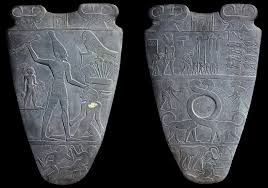
The Narmer Palette: Face A (Left) and Face B (Right)
Discovered in the Temple of Horus at Hierakonpolis, this siltstone palette is arguably the most important artifact from the dawn of history.
▶️ Face A: The Smiting
- Narmer dominates the scene, wearing the White Crown of the South.
- He grasps a northern enemy by the hair and raises a mace to strike—a pose that became the standard icon of pharaonic power.
- Horus (the falcon) holds a captive head emerging from the Delta marshes.
▶️ Face B: The Victory
- Narmer wears the Red Crown of the North, inspecting rows of bound and beheaded enemies.
- Two mythical serpopards (long-necked leopards) intertwine their necks, symbolizing the forced union of Upper and Lower Egypt.
- A bull destroys a walled city at the bottom.
✔ It serves as the "Birth Certificate" of Ancient Egypt.
Wars and Battles
Narmer's military campaigns were primarily internal, aimed at suppressing rebellion in the Delta (Lower Egypt) and consolidating control over the Nile Valley. However, artifacts also suggest campaigns into:
- Nubia: To secure trade routes and mineral resources.
- Canaan (Southern Levant): Pottery shards with his name found in Israel suggest an early Egyptian presence or military outpost there.
Governance & Administration
Narmer did not just conquer; he organized. He established the blueprint for the Egyptian state:
- Divine Kingship: He established the king as the sole intermediary between the gods and the people.
- Centralization: Created a bureaucracy to manage agriculture, taxation, and irrigation projects across the unified land.
- The Nome System: He likely began the division of Egypt into administrative districts (Nomes) governed by local nomarchs loyal to him.
The Capital: Memphis
To rule a unified Egypt, a new capital was needed at the junction of the two lands. Narmer (or his successor) founded Memphis (originally Ineb-Hedj, meaning "The White Wall").
Strategic Genius: Located at the apex of the Nile Delta, Memphis allowed the king to control trade routes to the Levant and manage the agriculture of the Delta while maintaining links to the Nile Valley in the south.
Religion & Ideology
Narmer formalized the concept of Ma'at (Order) vs. Isfet (Chaos). The king's primary duty was to maintain Ma'at by defeating enemies and honoring the gods.
- Horus Connection: The king was identified as the living embodiment of Horus, the falcon god of the sky and kingship.
- Neith: Evidence suggests he also honored Neith, a goddess of war and weaving from the Delta, perhaps to appease his new northern subjects.
Key Artifacts
Beyond the Palette, Narmer left other significant traces:
- Narmer Macehead: A limestone ceremonial mace depicting a religious festival (possibly a Sed festival) and the dedication of booty to the temple.
- Ivory Labels: Found in Abydos, showing early hieroglyphic writing recording events like the "Smiting of the East."
- Baboon Statue: An inscribed statue found in the hidden galleries of Saqqara bearing his name.
Tomb & Burial
Narmer was buried in the royal cemetery of Umm el-Qa'ab at Abydos. His tomb is identified as Tomb B17/B18.
It consists of two mud-brick lined chambers. Though small compared to later pyramids, it contained seal impressions and artifacts that confirm his high status and the beginnings of royal funerary cults.
Art in the Age of Narmer
The art of Narmer's reign set the canon for Egyptian art for the next 3,000 years. Key conventions established include:
- Hieratic Scale: Depicting the king larger than everyone else to show his importance.
- Registers: Organizing scenes in horizontal bands (registers).
- Composite Perspective: Showing the head in profile, shoulders frontally, and legs in profile.
Global Legacy
Narmer is one of the most important figures in human history because he created the world's first territorial state. Before him, societies were city-states or tribes. After him, the concept of a unified "Nation" with defined borders, a central government, and a single ruler became a reality that would influence all future civilizations.
📌 Comprehensive Summary
👑 Name: Narmer (The Striking Catfish)
🕰️ Era: Early Dynastic Period (c. 3200 BC)
⚔️ Greatest Feat: Unification of Upper and Lower Egypt
🪨 Legacy: Founder of the 1st Dynasty & Builder of Memphis

Monday, April 13, 2026
Luxor: Journey Through the World’s Greatest Open-Air Museum
While the pyramids near Cairo are iconic, it is Luxor—the ancient city of Thebes—that truly captures the unrivaled grandeur of ancient Egypt's peak. Nestled on the banks of the Nile, Luxor holds such a vast concentration of incredible monuments that it is rightly celebrated as the world’s greatest open-air museum.
For nearly 500 years, from the 16th to the 11th century BC, this city was the heart of Egypt’s power and religious devotion during the New Kingdom. Today, a single visit allows you to walk the paths of pharaohs, explorers, and the ancient gods themselves.
The East Bank: The Living City of Temples
The ancient Egyptians associated the East Bank of the Nile, where the sun rises, with life and resurrection. Here lie two monumental structures:
1. The Colossal Karnak Temple Complex
Karnak is not just a temple; it’s a vast, sprawling sacred site built over two millennia by successive pharaohs.
· Must-See: The Hypostyle Hall. Walking among its 134 massive sandstone columns, all still standing and some nearly 80 feet tall, is an experience of pure awe. Each column is covered in intricate relief carvings that once blazed with color.
· SEO Keyword Insight: For those searching for "massive ancient Egyptian columns" or "largest temple in Egypt," Karnak is the answer.
2. The Elegant Luxor Temple
Located in the heart of the modern city, Luxor Temple is more compact but exceptionally elegant. Unlike Karnak, it was not dedicated to a specific god but to the coronation of kings and the renewal of kingship. It is famously linked to Karnak by the recently restored Avenue of Sphinxes—a 2.7 km path once used for grand religious processions.
The West Bank: The Sacred City of the Dead
As the sun sets in the west, so the ancient Egyptians associated this bank with the afterlife. The cliffs of the West Bank are a treasure trove of hidden tombs and mortuary temples:
· The Valley of the Kings: The final resting place of pharaohs like Ramses II, Seti I, and, of course, Tutankhamun (KV62). Carved deep into the limestone, these tombs were designed to safeguard the spirits of the pharaohs and their treasures.
· The Valley of the Queens: Where the royal wives and children were buried, including the famous and stunningly decorated tomb of Queen Nefertari, the most beloved wife of Ramses II.
· The Mortuary Temple of Hatshepsut: A dramatic, terraced masterpiece that seems to grow right out of the mountain itself. It commemorates the famous female pharaoh, Hatshepsut, and her prosperous reign.
Experience the Magic: Why Luxor is Unmissable
A trip to Luxor is like stepping through a portal. Whether you are gazing at the monumental statues of the Colossi of Memnon or taking a hot air balloon ride over the temples at dawn, the scale and artistry of this ancient civilization will leave you speechless. It’s a place where history isn’t just studied; it’s felt.
Egypt Lover Tip: Make sure to visit Luxor Temple at night. The lighting dramatically accentuates the relief carvings and creates a mystical atmosphere you won't forget.
References / For Further Reading
1. Assmann, Jan. The Search for God in Ancient Egypt. (This book provides excellent insight into the religious motivation behind the Theban temples.)
2. Wilkinson, Richard H. The Complete Temples of Ancient Egypt. (A standard reference work for understanding the construction and purpose of Egypt’s monumental structures.)
3. Weeks, Kent R. (Editor). Valley of the Kings: The Tombs and the Funerary Temples of Thebes West. (Professor Weeks led the Theban Mapping Project, providing detailed archaeological context.)

Sunday, April 12, 2026
The Great Sphinx of Giza: The Eternal Guardian of the Plateau
For thousands of years, the Great Sphinx of Giza has stood as a silent sentinel, watching the sun rise over the Nile Valley. As one of the largest and oldest statues in the world, it remains a masterpiece of ancient engineering and a profound symbol of the Ancient Egyptian civilization.
The Architecture of a Legend
Carved directly from the limestone bedrock of the Giza Plateau, the Sphinx is a colossal figure with the body of a lion and the head of a human.
· Dimensions: It stretches about 73 meters (240 feet) long and 20 meters (66 feet) high.
· The Symbolism: The lion’s body represents strength and power, while the human head (widely believed to be Pharaoh Khafre) symbolizes intelligence and divine wisdom.
· The Orientation: The Sphinx faces due east, perfectly aligned with the rising sun, which was central to solar worship in Ancient Egypt.
Mysteries and Secrets of the Sphinx
Beyond its massive size, the Sphinx is surrounded by mysteries that continue to intrigue archaeologists and historians:
1. The Missing Nose
Contrary to the popular myth that Napoleon’s troops shot it off with a cannon, historical records suggest the nose was lost centuries before. Some Arab historians attribute the damage to a Sufi Muslim named Sa'im al-Dahr in the 14th century, who was angered by locals making offerings to the statue.
2. The Dream Stele
Between the Sphinx’s giant paws lies a massive granite slab known as the "Dream Stele." It tells the story of Prince Thutmose IV. Legend says he fell asleep in the Sphinx's shadow, and the statue spoke to him in a dream, promising him the throne of Egypt if he cleared the encroaching desert sands that buried its body.
3. Hidden Chambers?
For decades, rumors of secret tunnels and a "Hall of Records" beneath the Sphinx have circulated. While modern radar scans have detected some cavities and natural voids, no "secret library" has been officially discovered—leaving the mystery alive for future explorers.
The Sphinx Through the Ages
The Sphinx has witnessed the rise and fall of empires. At several points in history, it was buried up to its neck in sand, which actually helped preserve the delicate limestone from erosion and wind. It wasn't until the late 1930s that the entire body of the Sphinx was fully excavated and revealed to the world as we see it today.
Why You Must Visit
Standing before the Sphinx is a humbling experience. It is not just a statue; it is a bridge to the past. Whether you are a history buff or a casual traveler, seeing the Sphinx against the backdrop of the Great Pyramids is a "bucket list" moment that captures the true essence of Egypt.
Egypt Lover Tip: The best time to photograph the Sphinx is during the "Golden Hour" (just before sunset) when the limestone glows with a warm, orange hue, reflecting the majesty of the Pharaohs.

Subscribe to:
Posts (Atom)
Naunet: The Hidden Goddess of the Primeval Waters
SEO Metadata Focus Keyword: Naunet Egyptian goddess Meta Title: Naunet: The Feminine Waters of Egyptian Mythology Explained Meta Desc...

-
SEO Metadata Focus Keyword: Naunet Egyptian goddess Meta Title: Naunet: The Feminine Waters of Egyptian Mythology Explained Meta Desc...
-
Misr is the official Arabic name of Egypt, a name deeply rooted in history, language, and civilization. Far from being a modern designation...
-
A Masterpiece of Ancient Egyptian Sculpture Among the greatest masterpieces of ancient Egyptian art, the statue of King Khafre stands as a...


