The king who rejected the pyramid and closed an age.
𓊪𓋴𓋴𓂓𓆑
(Shepseskaf, "His Ka is Noble")
🕰️ Reign
c. 2503–2498 BCE
🏆 Monument
The Mastabat al-Fir'aun
📍 Location
South Saqqara
👑 Father
Menkaure
1
The Great Refusal: Abandoning the Pyramid
Shepseskaf, the last king of the mighty Fourth Dynasty, came to the throne after a century of unprecedented architectural achievement at Giza. The world expected him to build a fourth pyramid. He did not. In a shocking break with the tradition established by his father, grandfather, and great-grandfather, Shepseskaf abandoned Giza and its solar-stairway monuments entirely. He returned to Saqqara, the necropolis of the old kings, and built a tomb that was a deliberate and powerful rejection of the immediate past.
This decision has led to one of the great debates in Egyptology:
Was it an Economic Crisis? Did the colossal pyramid projects of Sneferu, Khufu, and Khafre finally bankrupt the state, leaving Shepseskaf unable to afford another?
Was it a Religious Rebellion? Was this a theological power struggle? By rejecting the pyramid—the ultimate symbol of the solar cult—was Shepseskaf attempting to curb the growing power of the priesthood of Ra at Heliopolis?
The truth is likely a combination of both. His reign marks a clear turning point, away from the absolute focus on the king's solar destiny and towards a new balance of power.
2
The "Pharaoh's Bench": A Return to the Archaic
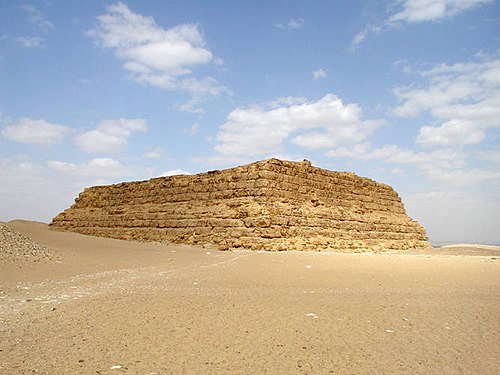
Shepseskaf chose to build his tomb not as a pyramid, but as a massive mastaba, the largest ever constructed for a king. Known today as the **Mastabat al-Fir'aun** ("Bench of the Pharaoh"), its design is a deliberate throwback to the tombs of the earliest dynasties.
The structure is not a pyramid but a giant, house-like rectangular building, shaped to resemble a huge sarcophagus or perhaps the archaic shrine of Lower Egypt. By adopting this ancient form, Shepseskaf was making a powerful ideological statement. He may have been emphasizing a return to the earthly foundations of kingship rather than the celestial aspirations of the pyramid builders. His very name, **"His Ka is Noble,"** focuses on the king's innate, earthly spirit (Ka) rather than his connection to the sun god Ra.
3
The End of a Dynasty and the Rise of the Sun Temples
Shepseskaf's reign was short, lasting only about four or five years. Before his death, he completed his father Menkaure's pyramid complex, but tellingly, he did so using mudbrick rather than the expensive granite his father had favored. This is another strong indicator of a shift in royal resources and priorities.
Shepseskaf's death marked the end of the direct male line of Sneferu's family. The throne passed to a new family, beginning with **Userkaf**, the founder of the Fifth Dynasty. It is believed that Shepseskaf's sister or wife, **Queen Khentkaus I**, may have played a crucial role in this transition, acting as a regent and legitimizing the new dynasty. With Userkaf, the solar cult that Shepseskaf may have resisted returned with a vengeance. The Fifth Dynasty kings abandoned giant pyramids and instead focused their wealth on building elaborate **Sun Temples** dedicated to Ra, confirming that the ideological struggles of Shepseskaf's reign had reshaped Egyptian religion for good.
4
Legacy: The King Who Closed an Age
Shepseskaf is a fascinating and enigmatic figure. He was the bookend to a spectacular era. His reign demonstrates that history is not a straight line of progress. He inherited the pinnacle of architectural knowledge and chose not to use it. Whether this was a choice born of piety, poverty, or politics, its effect was final.
He was the last king of the Fourth Dynasty, the last to be buried in a monument of such a colossal scale (even as a mastaba), and the last to hold the kind of absolute, centralized power that made the Giza pyramids possible. His reign is the definitive end of the golden age of pyramid building, a final, fascinating chapter in the story of Egypt's most iconic monuments.
[صورة المقال]: https://i.postimg.cc/q7V3J3Lf/Shepseskaf.jpg
𓊪𓋴𓋴𓂓𓆑
(Shepseskaf, "His Ka is Noble")
🕰️ Reign
c. 2503–2498 BCE
🏆 Monument
The Mastabat al-Fir'aun
📍 Location
South Saqqara
👑 Father
Menkaure
1
The Great Refusal: Abandoning the Pyramid
Shepseskaf, the last king of the mighty Fourth Dynasty, came to the throne after a century of unprecedented architectural achievement at Giza. The world expected him to build a fourth pyramid. He did not. In a shocking break with the tradition established by his father, grandfather, and great-grandfather, Shepseskaf abandoned Giza and its solar-stairway monuments entirely. He returned to Saqqara, the necropolis of the old kings, and built a tomb that was a deliberate and powerful rejection of the immediate past.
This decision has led to one of the great debates in Egyptology:
Was it an Economic Crisis? Did the colossal pyramid projects of Sneferu, Khufu, and Khafre finally bankrupt the state, leaving Shepseskaf unable to afford another?
Was it a Religious Rebellion? Was this a theological power struggle? By rejecting the pyramid—the ultimate symbol of the solar cult—was Shepseskaf attempting to curb the growing power of the priesthood of Ra at Heliopolis?
The truth is likely a combination of both. His reign marks a clear turning point, away from the absolute focus on the king's solar destiny and towards a new balance of power.
2
The "Pharaoh's Bench": A Return to the Archaic
Shepseskaf chose to build his tomb not as a pyramid, but as a massive mastaba, the largest ever constructed for a king. Known today as the **Mastabat al-Fir'aun** ("Bench of the Pharaoh"), its design is a deliberate throwback to the tombs of the earliest dynasties.
The structure is not a pyramid but a giant, house-like rectangular building, shaped to resemble a huge sarcophagus or perhaps the archaic shrine of Lower Egypt. By adopting this ancient form, Shepseskaf was making a powerful ideological statement. He may have been emphasizing a return to the earthly foundations of kingship rather than the celestial aspirations of the pyramid builders. His very name, **"His Ka is Noble,"** focuses on the king's innate, earthly spirit (Ka) rather than his connection to the sun god Ra.
3
The End of a Dynasty and the Rise of the Sun Temples
Shepseskaf's reign was short, lasting only about four or five years. Before his death, he completed his father Menkaure's pyramid complex, but tellingly, he did so using mudbrick rather than the expensive granite his father had favored. This is another strong indicator of a shift in royal resources and priorities.
Shepseskaf's death marked the end of the direct male line of Sneferu's family. The throne passed to a new family, beginning with **Userkaf**, the founder of the Fifth Dynasty. It is believed that Shepseskaf's sister or wife, **Queen Khentkaus I**, may have played a crucial role in this transition, acting as a regent and legitimizing the new dynasty. With Userkaf, the solar cult that Shepseskaf may have resisted returned with a vengeance. The Fifth Dynasty kings abandoned giant pyramids and instead focused their wealth on building elaborate **Sun Temples** dedicated to Ra, confirming that the ideological struggles of Shepseskaf's reign had reshaped Egyptian religion for good.
4
Legacy: The King Who Closed an Age
Shepseskaf is a fascinating and enigmatic figure. He was the bookend to a spectacular era. His reign demonstrates that history is not a straight line of progress. He inherited the pinnacle of architectural knowledge and chose not to use it. Whether this was a choice born of piety, poverty, or politics, its effect was final.
He was the last king of the Fourth Dynasty, the last to be buried in a monument of such a colossal scale (even as a mastaba), and the last to hold the kind of absolute, centralized power that made the Giza pyramids possible. His reign is the definitive end of the golden age of pyramid building, a final, fascinating chapter in the story of Egypt's most iconic monuments.
[صورة المقال]: https://i.postimg.cc/q7V3J3Lf/Shepseskaf.jpg


No comments:
Post a Comment