Tuesday, April 14, 2026

King Djer

1Identity & Names

Djer is one of the best-attested kings of the First Dynasty, with his name appearing on numerous artifacts from Abydos, Saqqara, and even outside of Egypt.


  • Horus Name: αΈ€r-Ḏr (Hor-Djer), meaning "Horus the Strong" or "Horus Who Endures," reflecting the stability and longevity of his reign.
  • Greek Tradition: He is possibly the king remembered as Uenephes in the later king-lists of Manetho.
  • Family: He was the son and successor of Hor-Aha. His mother is often identified as Khenthap.

2Chronology & Historical Importance

Djer's long reign (estimated at over 40 years) was a period of peace, stability, and significant economic growth. Following the unification by Narmer and consolidation by Hor-Aha, Djer's era was focused on building Egypt's wealth and international influence.

  • Reign: Approximately 3000 BCE.
  • Dynasty: First Dynasty, Early Dynastic Period.
  • Key Contribution: His reign marks the transformation of Egypt into a major regional economic power through the establishment of long-distance trade.

3Trade Expansion & Foreign Relations

Under Djer, Egypt's foreign contact expanded significantly, moving from tentative contact to established trade networks that brought immense wealth into the kingdom.

  • Trade with the Levant: Egyptian pottery and artifacts from Djer's reign have been found in southern Canaan (modern-day Israel and Palestine). In return, Egypt imported valuable timber (like cedar), olive oil, and other luxury goods.
  • Expeditions to Sinai: Inscriptions record expeditions to the Sinai Peninsula to secure valuable resources like copper and turquoise, essential for crafting tools, jewelry, and ceremonial objects.
  • Influence in Nubia: A rock inscription near Wadi Halfa (far south in Nubia) bears the name of Djer, proving Egyptian expeditions reached deep into Africa to control trade routes for gold and exotic goods.
This trade was not merely commercial; it was a tool of the state, likely managed by royal officials to fund the court, administrative projects, and grand burials.

4King Djer the Physician

The historian Manetho, writing thousands of years later, attributes a surprising skill to King Djer (whom he calls Athothis). He states that the king was a physician and that books on anatomy were written by him.

While no specific medical papyrus has been found directly authored by Djer, this tradition highlights the high esteem in which early kings were held regarding wisdom and knowledge. It suggests that during his reign, significant advancements in medicine and the understanding of the human body were made, possibly linked to the practices of mummification.

5Tomb, Burial, and Royal Jewelry

Djer's tomb at Umm el-Qaab, Abydos (Tomb O) is a powerful statement of his wealth and authority. It is one of the most significant tombs of the First Dynasty.

  • The Tomb of Osiris: Thousands of years later, in the Middle Kingdom, Egyptians believed Djer's tomb was the actual burial place of the god Osiris. It became one of the most sacred pilgrimage sites in all of Egypt.
  • Mass Retainer Sacrifice: Surrounding his tomb are the graves of over 300 courtiers and servants who were sacrificed to serve the king in the afterlife. This is the largest-known retainer sacrifice in Egyptian history.

The Jewelry of Djer

During the excavation of his tomb by Flinders Petrie, a mummified arm was discovered hidden in a wall crevice, likely belonging to a queen or a member of the royal family. On this arm were found four exquisite bracelets made of gold, turquoise, lapis lazuli, and amethyst.

These bracelets are among the oldest and finest examples of royal jewelry ever found. They demonstrate the incredible skill of First Dynasty goldsmiths and the wealth of the court, utilizing materials imported from Sinai and the Eastern Desert.

6Queen Herneith

Herneith was a prominent queen during the reign of Djer, possibly his wife. Her tomb at Saqqara (S3507) is significant for its size and architectural complexity, suggesting she held high status, perhaps even ruling as a regent or partner.

Her name honors the goddess Neith, a warlike deity from the Delta, indicating the continued importance of political alliances between Upper and Lower Egypt.

7Legacy & Historical Significance

Djer is remembered not as a conqueror, but as an empire-builder in the economic sense. He laid the material foundations for the future glory of Egypt.

His reign is significant for:

  • Economic Foundation: Establishing the trade networks that would fuel Egypt's economy for millennia.
  • Strengthening the State: Using the profits of trade to fund a more complex administration and grander royal projects.
  • Cultural Influence: The artifacts from his reign, especially the jewelry, show a marked increase in artistic sophistication and craftsmanship.
Uploaded Image

Menkaure

The king who chose perfection over size, builder of the Third Giza Pyramid.

π“ π“ˆ–π“†‘π“‚‹π“…±π“‚‹π“‚
(Men-Kau-Ra: "Eternal are the Souls of Ra")

πŸ•°️ Reign
c. 2530–2500 BCE

πŸ† Monument
The Third Pyramid

πŸ“ Location
Giza Plateau

πŸ‘‘ Father
Khafre

1
The Divine Pyramid: "Netjer-Menkaure"
Menkaure's pyramid, named "Netjer-Menkaure" (Menkaure is Divine), stands as a testament to the shift in royal ideology during the 4th Dynasty. Though significantly smaller than the pyramids of his father Khafre and grandfather Khufu (standing at 65 meters or 213 ft), it is widely considered the most beautiful in terms of craftsmanship and material value.

The Red Granite Casing: Unlike his predecessors who used fine white limestone for the entire casing, Menkaure opted for a much harder and more expensive material for the bottom 16 courses: Red Aswan Granite. This stone had to be quarried and transported over 900 km down the Nile from Aswan, making the effort per block significantly higher than local limestone. This gave the pyramid a unique, two-toned appearance: red at the base and white limestone at the top.
The Complex Interior: The substructure of Menkaure's pyramid is more complex than Khafre's. It features a descending passage, a panelled chamber, and a burial chamber lined entirely with granite. The arched ceiling of the burial chamber was carved on the underside to resemble a barrel vault, a sophisticated architectural feature.
Unfinished State: The granite casing was never fully smoothed, For More information visit us to  https://egyptlover.com/Menkaure

Shepseskaf

The king who rejected the pyramid and closed an age.

π“Šͺ𓋴𓋴𓂓𓆑
(Shepseskaf, "His Ka is Noble")

πŸ•°️ Reign
c. 2503–2498 BCE

πŸ† Monument
The Mastabat al-Fir'aun

πŸ“ Location
South Saqqara

πŸ‘‘ Father
Menkaure

1
The Great Refusal: Abandoning the Pyramid
Shepseskaf, the last king of the mighty Fourth Dynasty, came to the throne after a century of unprecedented architectural achievement at Giza. The world expected him to build a fourth pyramid. He did not. In a shocking break with the tradition established by his father, grandfather, and great-grandfather, Shepseskaf abandoned Giza and its solar-stairway monuments entirely. He returned to Saqqara, the necropolis of the old kings, and built a tomb that was a deliberate and powerful rejection of the immediate past.

This decision has led to one of the great debates in Egyptology:

Was it an Economic Crisis? Did the colossal pyramid projects of Sneferu, Khufu, and Khafre finally bankrupt the state, leaving Shepseskaf unable to afford another?
Was it a Religious Rebellion? Was this a theological power struggle? By rejecting the pyramid—the ultimate symbol of the solar cult—was Shepseskaf attempting to curb the growing power of the priesthood of Ra at Heliopolis?
The truth is likely a combination of both. His reign marks a clear turning point, away from the absolute focus on the king's solar destiny and towards a new balance of power.

2
The "Pharaoh's Bench": A Return to the Archaic
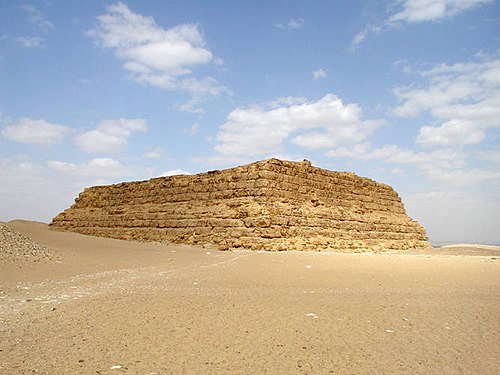
Shepseskaf chose to build his tomb not as a pyramid, but as a massive mastaba, the largest ever constructed for a king. Known today as the **Mastabat al-Fir'aun** ("Bench of the Pharaoh"), its design is a deliberate throwback to the tombs of the earliest dynasties.

The structure is not a pyramid but a giant, house-like rectangular building, shaped to resemble a huge sarcophagus or perhaps the archaic shrine of Lower Egypt. By adopting this ancient form, Shepseskaf was making a powerful ideological statement. He may have been emphasizing a return to the earthly foundations of kingship rather than the celestial aspirations of the pyramid builders. His very name, **"His Ka is Noble,"** focuses on the king's innate, earthly spirit (Ka) rather than his connection to the sun god Ra.
3
The End of a Dynasty and the Rise of the Sun Temples
Shepseskaf's reign was short, lasting only about four or five years. Before his death, he completed his father Menkaure's pyramid complex, but tellingly, he did so using mudbrick rather than the expensive granite his father had favored. This is another strong indicator of a shift in royal resources and priorities.

Shepseskaf's death marked the end of the direct male line of Sneferu's family. The throne passed to a new family, beginning with **Userkaf**, the founder of the Fifth Dynasty. It is believed that Shepseskaf's sister or wife, **Queen Khentkaus I**, may have played a crucial role in this transition, acting as a regent and legitimizing the new dynasty. With Userkaf, the solar cult that Shepseskaf may have resisted returned with a vengeance. The Fifth Dynasty kings abandoned giant pyramids and instead focused their wealth on building elaborate **Sun Temples** dedicated to Ra, confirming that the ideological struggles of Shepseskaf's reign had reshaped Egyptian religion for good.

4
Legacy: The King Who Closed an Age
Shepseskaf is a fascinating and enigmatic figure. He was the bookend to a spectacular era. His reign demonstrates that history is not a straight line of progress. He inherited the pinnacle of architectural knowledge and chose not to use it. Whether this was a choice born of piety, poverty, or politics, its effect was final.

He was the last king of the Fourth Dynasty, the last to be buried in a monument of such a colossal scale (even as a mastaba), and the last to hold the kind of absolute, centralized power that made the Giza pyramids possible. His reign is the definitive end of the golden age of pyramid building, a final, fascinating chapter in the story of Egypt's most iconic monuments.

[ءورة Ψ§Ω„Ω…Ω‚Ψ§Ω„]: https://i.postimg.cc/q7V3J3Lf/Shepseskaf.jpg

Khafre

The king who sculpted the Sphinx and perfected the Giza plateau.

𓐍𓂝𓆑𓂋𓂝
(Khafre, "He Appears Like Ra")

πŸ•°️ Reign
c. 2558–2532 BCE

πŸ† Monuments
Pyramid & Sphinx

πŸ“ Necropolis
Giza

πŸ‘‘ Son & Heir
Menkaure

1
The Giza Vision, Realized
After the brief interlude of Djedefre's reign at Abu Rawash, the royal lineage returned to Giza with Khafre, another son of the great Khufu. Khafre's mission was clear: to complete the grand vision for the Giza necropolis that his father had started. He didn't just build another pyramid; he created a unified, sacred landscape, linking his own monument to his father's with a level of artistic and architectural harmony that has never been surpassed.

2
The Second Pyramid: A Masterpiece of Illusion
At first glance, Khafre's pyramid appears taller than his father's Great Pyramid. This is a deliberate optical illusion. By building on a bedrock foundation that was 10 meters (33 ft) higher, Khafre ensured his monument would seem to dominate the skyline, a clever act of reverence and rivalry. While slightly smaller, its steeper angle makes it a breathtaking sight.

The Glimpse of Perfection: Khafre's pyramid is unique because it retains a portion of its original polished Tura limestone casing at its apex. This "pyramidion" gives us our only real glimpse of how the Giza pyramids originally looked: not as the rough, tiered structures of today, but as gleaming, white, seamless monuments that would have dazzled in the Egyptian sun.
Efficient Design: Learning from the complex interior of his father's pyramid, Khafre opted for a much simpler design with two entrances and a single burial chamber carved into the bedrock, demonstrating a focus on efficient construction and external perfection.
3
The Guardian of Eternity: The Great Sphinx
Khafre's most iconic and mysterious legacy is undoubtedly the Great Sphinx. Carved from a single, massive outcrop of limestone left over from the quarrying for Khufu's pyramid, it is the largest monolithic statue in the world. The evidence tying it to Khafre is overwhelming:

The face of the Sphinx bears a striking resemblance to the known, idealized portraits of Khafre from his statues. More conclusively, the causeway from Khafre's pyramid complex leads directly to the Sphinx Temple situated in front of the monument. The Sphinx was not a random creation; it was an integral part of Khafre's funerary complex, acting as a colossal, divine guardian for the entire Giza necropolis, the embodiment of the king as the sun god watching the eastern horizon in anticipation of his own rebirth.
4
The Valley Temple and the Diorite Masterpiece
At the end of the causeway lies Khafre's Valley Temple, a marvel of Old Kingdom architecture. Built with massive core blocks of limestone and cased entirely in huge, polished slabs of red granite, its stark, minimalist design exudes a feeling of eternal power. This temple was the site of the final purification and mummification rites for the king.

It was within this temple that one of the greatest treasures of ancient art was discovered: the **life-sized diorite statue of Khafre**. This masterpiece, now in the Egyptian Museum in Cairo, depicts the king seated on his throne in perfect, serene majesty. Behind his head, the falcon god Horus spreads his wings in a protective embrace, a seamless fusion of the human and the divine. Carved from a block of incredibly hard diorite stone, it is a statement of absolute power and the pinnacle of Old Kingdom royal sculpture.

5
Legacy: The Master of the Giza Plateau
If Khufu was the master engineer, Khafre was the master artist and planner. He didn't just build beside his father; he harmonized with him, creating a landscape where the Second Pyramid, the Sphinx, the temples, and the causeways all work together in a single, unified theological and architectural statement. He inherited the title "Son of Ra" and gave it an awe-inspiring physical form.

He passed this completed vision to his son, **Menkaure**, who would add the third and final pyramid to the plateau. While Menkaure's pyramid was smaller, it marked the completion of a three-generation family project that has defined our image of ancient Egypt and has captivated the world for 4,500 years. Khafre's reign represents the perfect, confident balance of power, art, and faith, carved for eternity on the Giza plateau.

[ءورة Ψ§Ω„Ω…Ω‚Ψ§Ω„]: https://i.postimg.cc/dVWp47d8/Khafre.jpg

Djedefre

The revolutionary pharaoh who first called himself "Son of Ra."

𓂋𓂧𓆑
(Radjedef, "He Endures Like Ra")

πŸ•°️ Reign
c. 2566–2558 BCE

πŸ† Innovation
First "Son of Ra"

πŸ“ Necropolis
Abu Rawash

πŸ‘‘ Father
Khufu

1
The "Son of Ra": A Religious Revolution
After the monumental reign of his father Khufu, Djedefre came to the throne and immediately initiated one of the most significant ideological shifts in Egyptian history. He was the very first pharaoh to add the title **Sa-Ra (𓅭𓇳)**, meaning **"Son of Ra,"** to the royal titulary. This was not a minor change; it was a redefinition of kingship.

Previously, the king's primary divine identity was as the living embodiment of the falcon god Horus. By declaring himself the physical son of the sun god Ra, Djedefre inextricably linked the monarchy to the powerful and increasingly dominant solar cult based at Heliopolis. This title became a permanent fixture for every pharaoh who followed, cementing the idea that the king was of divine parentage, destined to join his father Ra in his solar barque after death.

2
The Enigma of Abu Rawash: A Break with Tradition
In a move that continues to baffle Egyptologists, Djedefre abandoned the Giza plateau—the necropolis of his powerful father—and chose to build his pyramid complex at **Abu Rawash**, 8 kilometers to the north. This decision has sparked intense debate:

Was this a **political statement** against the Giza branch of his family, including his brother Khafre? Or was it a **profoundly religious choice**? The high plateau of Abu Rawash was closer to Heliopolis, the center of Ra worship, and from its vantage point, Djedefre's pyramid would have been the first monument to catch the morning sun and the last to see it set. It was, in effect, a solar monument, a "throne of Ra" on the horizon. This bold move underscores the depth of his commitment to the new solar theology.
3
The "Lost" Pyramid and the First Sphinx?
Djedefre's pyramid was never finished, likely due to his short reign of around eight years. In Roman times, it was heavily used as a quarry, leaving only its base and subterranean chambers today. However, excavations have revealed a project of immense ambition and innovation:

Advanced Construction: The burial chamber and the base of the pyramid were constructed with massive granite beams, showing a continued mastery of heavy stone engineering.
The First Royal Sphinx? Excavations at the site have uncovered fragments of what many scholars believe to be the **first-known royal sphinx**. This suggests that Djedefre, not Khafre, may have been the originator of the iconic image of a king's head on a lion's body, an idea later perfected on a colossal scale at Giza.
A King's Face: The most beautiful portraits of Djedefre, including a famous quartzite head now in the Louvre, were found in his pyramid complex, showcasing a new level of realism and sensitivity in royal art.
4
Legacy: An Idea More Powerful Than Stone
After Djedefre's short reign, the throne returned to Giza with his brother (or half-brother) Khafre. For a long time, historians believed that Djedefre's memory was intentionally suppressed and his pyramid destroyed by his successors as retribution for his "heretical" move to Abu Rawash. However, modern research shows that his pyramid was quarried much later and that his name was respected by his immediate successors.

Djedefre's true legacy was not his unfinished pyramid, but his powerful idea. His "Son of Ra" title was so compelling that it was immediately adopted by his successor Khafre and every king of Egypt thereafter. The solar theology he championed became the state religion, leading directly to the construction of sun temples in the Fifth Dynasty. Though his reign was brief and his monument is a ruin, Djedefre's ideological revolution forever shaped the course of ancient Egyptian civilization.

[ءورة Ψ§Ω„Ω…Ω‚Ψ§Ω„]: https://i.postimg.cc/T1XPkNmW/Djedefre.png

King Khufu

The pharaoh who built the Great Pyramid of Giza.

𓐍𓅱𓆑𓅱
(Khufu)

πŸ•°️ Reign
c. 2589–2566 BCE

πŸ† Monument
The Great Pyramid

πŸ“ Location
Giza Plateau

πŸ‘‘ Father
Sneferu

1
Akhet Khufu: "The Horizon of Khufu"
Khufu's Great Pyramid is not merely a tomb; it is a masterpiece of mathematics, logistics, and engineering that has baffled and fascinated humanity for over 4,500 years. For more than 3,800 years, it stood as the tallest man-made structure on Earth, a symbol of the absolute power and divine status of the pharaoh.

Colossal Scale: Constructed from an estimated 2.3 million stone blocks, weighing a total of 6 million tons, its original height was a staggering 146.6 meters (481 ft).
Astronomical Precision: The pyramid is aligned to true north with an accuracy of within 3/60th of a degree. The so-called "air shafts" are not for ventilation; they are precisely angled to point to specific circumpolar stars (like Thuban, the pole star of that era) and the constellation of Orion, linking the king's soul directly to the indestructible, eternal stars.
2
Inside the Horizon: The Architecture Within
Unlike other pyramids that have simple substructures, Khufu's pyramid contains a complex system of chambers high above ground level, showing the evolution of the royal plan during construction.

The Subterranean Chamber: Carved deep into the bedrock but left unfinished, suggesting an initial plan to bury the king below ground that was later abandoned.
The Queen's Chamber: Located in the middle of the structure. Despite its name (given by early explorers), it was likely a "Serdab" room for the king's Ka statue, not a burial place for a queen. It features mysterious shafts blocked by limestone doors with copper handles.
The Grand Gallery: An engineering marvel. This 47-meter-long corbelled hall has a soaring 8.6-meter high ceiling. It served a dual purpose: as a ceremonial pathway and a mechanism to store the massive granite blocks used to seal the Ascending Passage.
The King's Chamber: The heart of the pyramid, built entirely of red Aswan granite. It contains the lidless granite sarcophagus. Above it lie five "relieving chambers" designed to distribute the immense weight of the masonry above, preventing the burial chamber from collapsing.
3
The Myth of the Tyrant: Who Really Built the Pyramids?
The Greek historian Herodotus, writing 2,000 years after Khufu's reign, painted him as a cruel tyrant who enslaved 100,000 men to build his monument. For centuries, this was the accepted story. Modern archaeology, however, tells a very different tale.

Excavations led by Dr. Mark Lehner and Dr. Zahi Hawass have uncovered the **workers' village** at Giza. This was not a slave camp, but a highly organized city. Evidence from bakeries shows that thousands of loaves of bread were baked daily. Animal bone analysis reveals that the workers were fed prime cuts of beef, a luxury in ancient Egypt. Their own cemetery, with tombs containing bread and beer for the afterlife, shows they were honored citizens, not disposable slaves. These were skilled Egyptian craftsmen and laborers who worked in three-month rotating shifts, likely as a form of national service or taxation (corvΓ©e labor) during the Nile's inundation period when farming was impossible.
4
The Diary of Merer: A First-Hand Account
The most stunning blow to the slavery myth came in 2013 with the discovery of the **Wadi al-Jarf Papyri**. These documents include the logbook of an official named Merer, who led a team of 40 elite workers. Merer's diary, the oldest papyrus ever discovered, provides a day-by-day account of his team's work during the final years of Khufu's reign.

He describes quarrying the fine white Tura limestone used for the pyramid's outer casing, loading it onto boats, and sailing it down the Nile and through a series of canals directly to the Giza harbor (Ro-She Khufu). This incredible document gives us names, dates, and logistics, proving the Great Pyramid was built by a highly organized, state-managed workforce of skilled Egyptians.

5
The Solar Ships: Journey to the Afterlife
In 1954, near the southern face of the Great Pyramid, archaeologists discovered a sealed pit containing a dismantled cedarwood ship. Known as the **Khufu Solar Ship**, it is one of the oldest, largest, and best-preserved vessels from antiquity.

Design: The ship is 43.6 meters long and was constructed using "sewn" planks of Lebanese cedar, without a single nail. It was likely used to transport the king's body from Memphis to Giza or intended symbolically for his journey with the sun god Ra across the heavens.
Second Boat: A second boat pit was excavated in recent years, and its contents are being restored to join the first ship in the new Grand Egyptian Museum (GEM).
6
The Royal Court & The Masterminds
Khufu did not act alone. He was surrounded by a brilliant and powerful family who managed the state.

Hemiunu (The Architect): Khufu's nephew and vizier. He is credited as the mastermind behind the Great Pyramid. His statue, found at Giza, depicts a man of great authority and corpulence, a sign of prosperity.
Ankhhaf: Khufu's half-brother, who served as vizier during the later part of the reign. He likely oversaw the completion of the pyramid complex. His realistic bust is a masterpiece of Old Kingdom art.
Queen Hetepheres I: Khufu's mother and the link to the previous dynasty. Her secret tomb at Giza contained dazzling gold furniture, proving the immense wealth of the royal house.
7
Succession and the Family Drama
Khufu had several wives and many children, which led to a complex succession after his death. It was not his famous son Khafre who immediately succeeded him. The throne first passed to another son, **Djedefre**.

In a move that suggests a possible family rift or religious shift, Djedefre abandoned Giza and began building his own pyramid complex at Abu Rawash, several kilometers to the north. He was also the first pharaoh to officially adopt the title "Son of Ra," cementing the solar cult's dominance. Only after Djedefre's reign did the throne return to Giza with Khafre.

8
Modern Science: The "Big Void"
The Great Pyramid has not revealed all its secrets. In 2017, the **ScanPyramids** project, using cosmic-ray muon radiography, announced the discovery of a massive empty space within the pyramid, dubbed the "Big Void."

Located above the Grand Gallery and approximately 30 meters long, this void's purpose remains unknown. Is it a construction gap? A hidden chamber? Or a stress-relieving structure? It proves that even after 4,500 years, Khufu's monument still holds mysteries waiting to be solved.
9
Legacy: The Man and the Monument
It is the greatest irony of Khufu's reign that the man who built the largest monument in ancient history is known to us by only one confirmed, complete statue: a tiny, 7.5 cm (3-inch) ivory figurine discovered not at Giza, but hundreds of kilometers away in Abydos. While Herodotus painted him as a tyrant, Egyptian sources like the Westcar Papyrus show him as a king fascinated by magic and the limits of knowledge.

In the end, Khufu's personality is eclipsed by his creation. The Great Pyramid is his true legacy. It is the ultimate statement of divine kingship and human potential, a man-made mountain of stone and mathematics designed to launch the king's soul into the eternal cosmos. It is a monument so perfect and so audacious that it continues to define our perception of ancient Egypt and stands as a permanent challenge to the limits of human achievement.

[ءورة Ψ§Ω„Ω…Ω‚Ψ§Ω„]: https://i.postimg.cc/LszM89wr/Khufu.jpg

Sekhemkhet

1The Heir to a Revolution

Sekhemkhet, whose name means "Powerful of Body," inherited the most prosperous and technologically advanced kingdom the world had yet seen. As the successor to the legendary Djoser, he was poised to continue the architectural revolution that had just begun. He commanded a unified nation, a loyal administration, and, most importantly, the visionary architects and skilled stonemasons who had just completed the world's first pyramid. The expectation was clear: he would build upon his predecessor's legacy and create something even grander.

2The Buried Pyramid: Discovery of a Lost King

For millennia, Sekhemkhet was little more than a name on a king list. His story remained lost until 1951, when Egyptian archaeologist Zakaria Goneim noticed a strange, rectangular shape in the desert at Saqqara. He began to excavate what he believed to be an unfinished pyramid enclosure. What he found was the rediscovery of a lost pharaoh.

The project was ambitious: a massive enclosure and a step pyramid planned to have seven steps, soaring to over 70 meters—taller and more refined than Djoser's. But construction had barely begun, with only the first step reaching a height of a few meters. The reason became clear: the king's reign was tragically short. Despite this, the subterranean structure was complete, and deep within, Goneim found the burial chamber. There stood a breathtaking sight: a single, magnificent sarcophagus carved from a block of translucent alabaster, its sliding portcullis door still sealed with plaster. It had remained untouched for over 4,600 years.

3The Mystery of the Empty Sarcophagus

The discovery of a sealed, intact royal sarcophagus from the Old Kingdom was one of the greatest archaeological finds of the 20th century. The world held its breath. On June 26, 1954, before government officials and the international press, Goneim and his team prepared to open the sarcophagus. With immense effort, they raised the heavy sliding door.

They peered inside. It was completely, utterly empty. There was no mummy, no jewelry, no artifacts. The discovery was as baffling as it was disappointing. How could a perfectly sealed sarcophagus, untouched since the day it was closed, be empty? This question has given rise to several compelling theories:

4Architectural Significance: "Pyramid 2.0"

The Imhotep Connection: Proof of continuity was found on the enclosure wall—a red ink inscription naming the famous architect Imhotep. This confirms he survived Djoser and continued to serve as the royal architect for Sekhemkhet, applying his genius to this second attempt at a pyramid.

5The Treasures of the North

While the sarcophagus was empty, the pyramid complex was not without its wonders. In the main corridor, Zakaria Goneim discovered a hoard of gold jewelry that had escaped the notice of tomb robbers. This find is one of the oldest collections of royal gold jewelry ever found in Egypt.

These artifacts, now in the Egyptian Museum, provide a rare glimpse into the wealth and craftsmanship of the Third Dynasty, proving that Sekhemkhet's reign, however short, was one of immense opulence.

6The Sinai Inscriptions: Proof of Power

Sekhemkhet was not an idle king. Far from Saqqara, at Wadi Maghareh in the Sinai Peninsula, stunning rock reliefs depict him in the traditional "smiting the enemy" pose. These inscriptions serve two vital purposes: they prove his active foreign policy and interest in mining turquoise and copper, and they confirm his identity by linking his Horus name (Sekhemkhet) with his birth name (Djeser-Teti), solving a major historical puzzle for Egyptologists.

7Legacy: The Enduring Puzzle

Sekhemkhet's reign was too short to leave a major mark on history through conquests or grand edicts. His legacy is his phantom pyramid and its unsolved puzzle. He is a testament to the fact that even for a divine king with unlimited resources, grand ambitions can be cut short by fate. His project, frozen at the moment his reign ended, offers a unique window into the minds of the ancient builders and leaves us with one of Egypt's most tantalizing questions: what really happened to the body of King Sekhemkhet?

Uploaded Image

5 Weird Daily Habits of Ancient Egyptians That Will Surprise You

When we think of Ancient Egypt, we often imagine stern Pharaohs, massive pyramids, and mysterious rituals. However, beneath the golden mas...